For lenders
Every R01 return is a payment you already counted as collected. Per-call balance checks add cost on every retry, and still clear debits that come back.

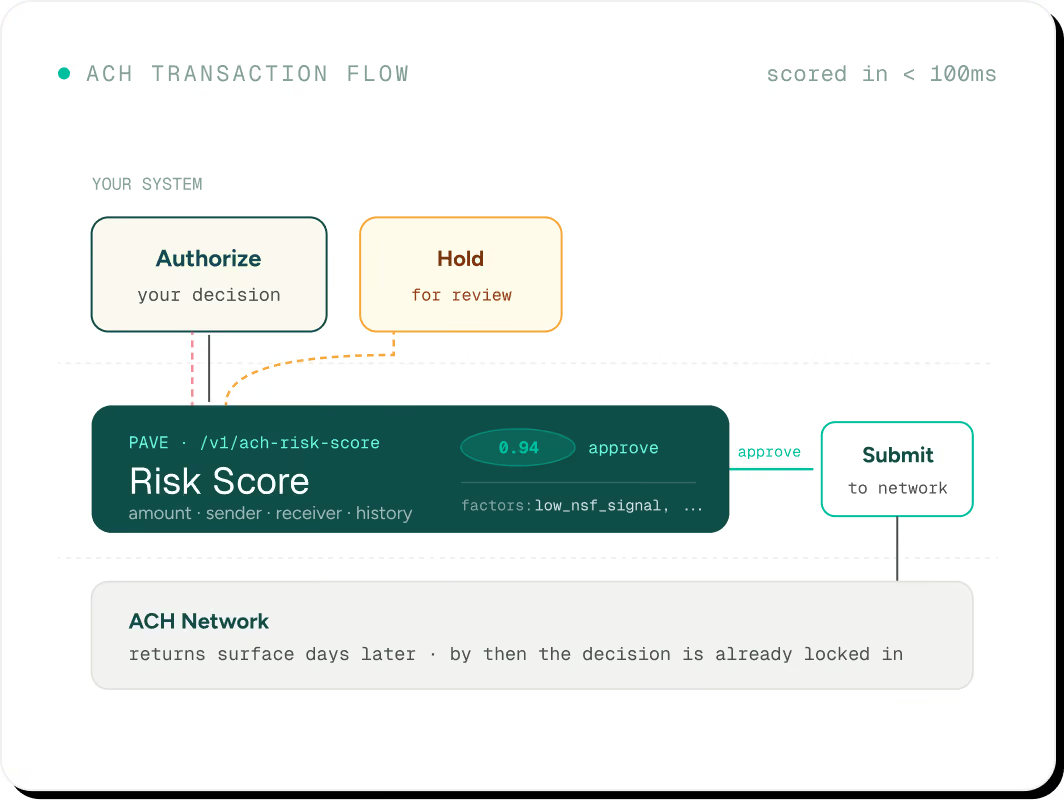
Live balance checks don't predict returns. Pave ACH Risk Score reads the cashflow signals that actually move with risk and scores every ACH before it's sent. Real-time, explainable, and tunable by attempt type.
One of the Pave Cashflow Scores, the family of risk-event-tuned scores built on Pave's enriched cashflow data.
.avif)


.avif)
.avif)


.avif)

%20(4).avif)
.svg)













Where Returns Come From
Most ACH risk controls answer the wrong question. A balance check confirms funds at the moment of submission. But a user can appear to have the funds, say $300 at 2pm, and still return because their balance is back to $0 by the time the debit settles. By then the customer has been notified and the cost is on your books. The decision had to happen before you sent the entry.
For lenders
Every R01 return is a payment you already counted as collected. Per-call balance checks add cost on every retry, and still clear debits that come back.
For EWA & Cash advance
Return rates drift toward the NACHA threshold as your new-user mix grows. A static rule deployed once drifts out of compliance.
For fintechs & BaaS
Account validation catches ownership, not behavior. Sponsor banks ask for return-rate controls every quarter.
Pave ACH Risk Score
Pave ACH Risk Score reads balance trajectory, paycheck cadence, and recent return history, then returns the odds the attempt comes back. It learns from real outcomes across our network. Every debit our lenders run, settled or returned, trains the score, which updates as each borrower's balance and deposits change.

Balance checks tell you funds are present right now. Pave returns the probability the debit comes back, read from cashflow behavior the snapshot can't see.

Set separate operating points for due-date submissions and overdue retries (different risk, different cutoffs), and re-tune as your population shifts.

The score runs on enriched cashflow data from the bank account, the same data your team already uses to underwrite. One API call, no new pipeline to stand up.
How It Works
Score it in-line before submission, or batch a file before it goes out.
Against the bank cashflow data: a probability the attempt returns, with the factors behind it.
Submit, hold, or retry against the thresholds you set.
Proof
Where It Fits
Pave is the AI credit infrastructure for lenders. ACH Risk Score is one of the Pave Cashflow Scores: risk-event-tuned scores that all read from the same enriched cashflow data, so the signal you score an ACH retry with is the same signal behind every other Pave score.
Cleans, standardizes, and categorizes raw bank transaction data into consistent, reliable signals.
Thousands of derived cashflow features (income, spending, and repayment patterns), ready to plug into any model.
Thousands of derived cashflow features (income, spending, and repayment patterns), ready to plug into any model.
Agentic credit modeling on top, so your team can build and own custom models for any risk event, in days. You keep the model and the judgement; the agent does the mechanical work.
Use Cases
.svg)
Separate operating points for due-date submissions and overdue retries
Concentrate returns in the top-risk decile so operations has a precise lever
Re-tune thresholds as your new-user mix shifts, holding compliance margin through portfolio change
Recover compliance without throttling advance volume

Score ACH return risk at the moment of payment, so you can release the limit immediately for payments you can confidently clear
Cut the held-funds window that drives support tickets, confusion, and churn
A servicing and compliance win that doesn’t touch your underwriting policy
Built for card programs, neobanks, and pay-down-to-free-up-limit flows
Score each debit and retry for return risk before the entry is sent
Replace a per-call balance-check vendor with a score that reads the cashflow data you already have
Explainable factors on every score for ops, audit, and sponsor-bank review
Built for personal loans, BNPL, POS finance, and small-dollar lending
Pave Index · Vol. 01
2026 Industry Report
Return codes, predictability, and what well-run programs actually hit. Across $400B in flows.
Our team will walk you through how lenders and fintechs use Pave to analyze cashflow data, score applicants with confidence, and grow sustainably—without increasing risk.